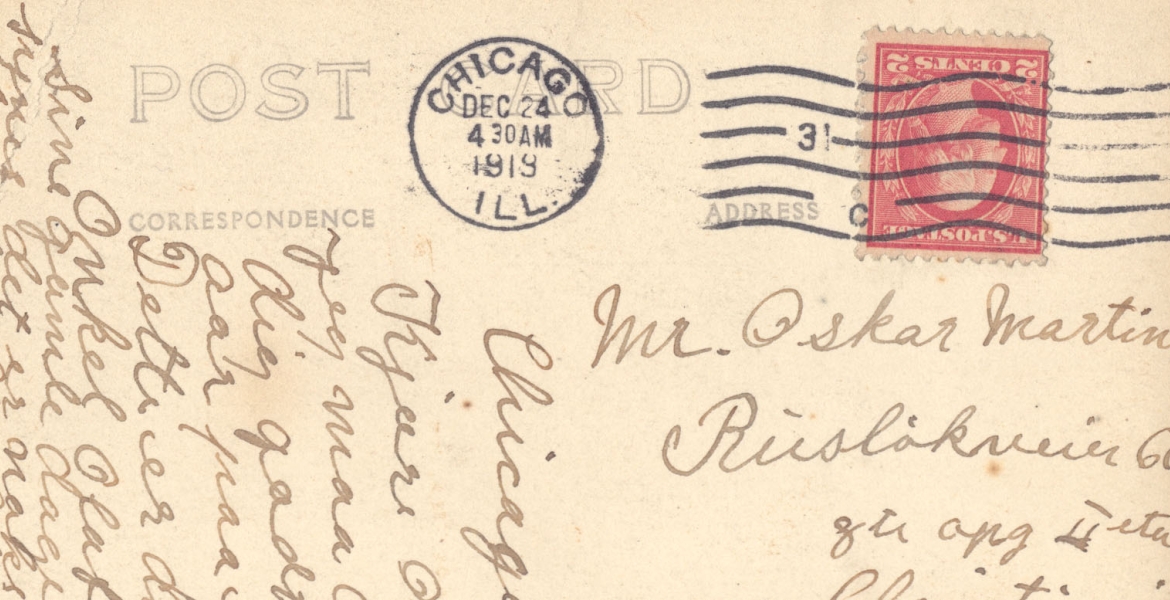
Gammelt postkort fra Chicago
Many people using genealogy in relation to the US find out that their ancestors changed their name when they arrived to their new home. Here you will find some typical name changes, and some tips for how to find those that performed these changes.
Tekst gruppe
Av

The choice to Americanise their name

The fact that Grandma’s brother Georg Bernhard August Madsen chose to Americanise his name after almost 70 years living on the North-American continent is not that strange. The spelling George B. Matsen probably made it easier to fit in in the English-speaking community, and he did not need to spell out his name daily. Why a different relative, August Johansen, chose to call himself Carl August Wickstrom during his 26-year stay in the US is not as obvious, and completely impossible to find the reason for the name choice; he had no close relatives with the first name Carl, and he did not have any known relation to any Wickstrøm-family.

In this article we are going to look more into some common name change patterns Norwegian immigrants could be inspired by. Furthermore, we are going to look at how these name changes can influence the information we find in the American source material, not just on the emigrants themselves, but also on their Norwegian origins. Throughout this article we will look at relevant sources that hopefully can help lead us through the jungle of name changes.

Names were not changed at Ellis Island

A very long lived myth, both among Norwegian and American genealogists, is that emigrants had their names changed to more or less recognisable anglicised versions of their names at Ellis Island. This myth has not ties to reality; a fact both authors of American books on genealogy and historians on Ellis Island regularly tries to point out, but it does not seem to stick. Philip Sutton writes about this in the blog entry “Why Your Family Name Was Not Changed at Ellis Island (and One That Was)” published at New York Public Library’s websites. Here it is pointed out that the officials at Ellie Island used already filled in lists from the ships as the basis for the arrival registrations of the passengers, and therefore they did not note down the emigrants’ data themselves. When the emigrants still chose to change their name and/or be registered with different versions of their names in English and Norwegian sources, there were different reasons for this.

August Johansen og Doris Irene Wickstrom

August Johansen/Carl August Wickstrom with his daugther Doris Irene Wickstrom. Passport photography taken at their return to Norway in 1936. Doris changed her last name from Wickstrom to Johansen. Photo: Private

A way to fit in in a new community

A name change could in certain circumstances happen even before the departure from the homeland, especially if other relatives had left before them. Hans Peter Christiansen came from one of the Vister-farms in the Hærland parish in Eidsberg. Early in the 1880’s he left his family in Kristiania (Oslo) to try his luck in America. In the spring 1882 his wife Kaja took their five kids with her and followed him. In the digital archive in the database “Emigranter over Kristiania 1871-1930, redigert utgave” (Emigrants over Kristaiania 1871-1930, revised version), we find all of them registered with the Amrican last name Wester. Letters between Hans and Kaia have crossed the Atlantic! Norwegian Vinster- farms have probably been the source of several Vinster- and Winster- last names in Norway. It is not unreasonable to assume that they could be the origins of the American last name Wester, at least not when you already have the answers.

The name changes of many immigrants were similar. The changes are not necessarily big, but you need a bit of creativity to come up with them! The example of George B. Matsen is anexample of this. Such a name change does not create great difficultes for us when we are looking for him now either, as long as we account for different spelling and mistakes that could have been made when it was written down. Please notice that he spelled his name with the traditional Norwegian ending -sen. Other immigrants in the Madsen-family chose, as so many others, more anglophone versions of their names with the ending -son: Madson and Matson. This ended up being the case for George too, even though he had no part in it. On his gravestone at the Crown Hill Cemetery in Seattle, Washington, he is wrongly called “George B. Matson”

Changing their first name

In the book Slektsgranskerens guide til utvandringen 1825-1930, author Liv Marit Haakenstad have an entire chapter devoted to names. Here she writes about the laws relation to names in the USA, or rather the lack there of. In addition she also writes lists of the normal name changes and the normal americanization of certain names. It is not difficult to imagine Andreas becoming Andrew, and Per, Peder and Petter would all become Peter. It might not be as obvious that Guro could become Julia and that Sigrid could become Sarah. I looked for a long time for my great grandmother’s half sister Gina Mathea Andreasdatter Sammerud from Skiptvet. She became Jennie M. Anderson féroce she married and changed her last name again. Later in this article we will look at how to find women that got a new last name when married.

Changing -sen names

We have already looked at how Madsen could become Madson in the USA, in the same way Johansen or Johannesen often ended up as Johnson. It is important to remember that during the great emigration time period, many people in Norway still used patronymics, their father’s first name plus the ending -sen or -datter. There was nothing similar in use where they arrived. In the English speaking parts of the US, people had fixed last names. A group of immigrants consisting of parents and children therefore usually ended up using the father’s last name as the last name for everyone when arriving in the new country.

In many families the emigration was done in pools. The father of the family would go first, and a few years later the wife and children would follow. Or perhaps the oldest child, Johannes Pedersen, would be the first one to travel across the ocean, before the younger siblings would travel one after another. Finally, only the parents Peder Olsen and Kari Gulbrandsdatter were left in Norway. Peder died there a few years later. A letter from America would arrive for Kari, telling her that she noo  had to travel across the ocean to join her son John Peterson, as he now called himself, and live with him for the rest of her days. The change was undoubtedly great for Kari Gulbrandsdatter, and she even got a new name. In America, where they had fixed last names, Mr. Peterson’s mother couldn’t be named anything other than Mrs. Peterson! And thus, Kari got a fixed last name from her own husband’s first name. This can seem strange, but we find the same phenomena at times in Norway too, especially in urban areas, and it is mentioned in the book Hva er et navn? (What is a name?) by Ivar Utnes.  

Changing farm names

Remember that many emigrants shortened long and difficult last names based in Norwegian farm names, just like we can see they have done over time back home. This is how the Norwegian-American priest and chairman in the United (Norwegian-Lutheran) church of America, Theodor Halvorsen Smaadahl - from the Smådahl farm in the Båstad parish in Trøgstad- came to be known as Theodor H. Dahl. Notice that he kept his first name unchanged. In this case, a typical American change would be Theodore, and this is something we have to keep in mind when searching for him; one thing is what changes the emigrant themselves made, another matter is the different versions of their names that we can find in American sources. Even in the Norwegian-American newspaper Nordisk Tidende we can find his name sometimes spelled “Theodore” in his obituary printed the 25th of January 1923. We can easily find the newspaper through the national library’s website.

A good advice, especially when it comes to changes to last names, is to try to say the name out loud both in Norwegian and in English, and then writing them down in English the way it sounds. Using this method, it is easy to see how the Norwegian last name Lie ended up as Lee in the US.

It is also worth noting that many first generation immigrants lived in areas dominated by Norwegians. In those areas, Norwegian names and naming traditions did not pose much of a problem from day to day. Therefore, in such situations people would often keep their norwegian names, whilst over time they would use names more suitable for English when meeting the rest of the American society. Therefore, people could easily have two names at the same time, depending on the situation. Norsk namnelag (NNL) have an article on their website concerning Norwegian last names in America, (Norske etternamn i Amerika), which is worth a read. In it you will also find more tips regarding literature.

What we cannot use reason to find out

So far in this article we have looked mostly at name changes where Norwegian first and last names in some ways have been modified and changed to fit the english speaking society the emigrants met. What about the name changes we do not have the ability nor the fantasy to come up with?

A good strategy if we lose a whole part of a family, is to do some kind of parent or sibling search at a website that offers searching in american census’. In the Wester family, six children were born before the father, Hans, left Norway. One son died early. By looking at the first names and the birth dates to the parents and the other children in different combinations, it is possible to find the family in the US, even without knowing the new last name Wester. This was actually the method I used to find them, and after that I was able to find the mother and children as emigrated in Norwegian sources. In can be more difficult to find lonely emigrants, such as August Johansen/Carl August Wickstrom. In these cases, other strategies have to be used.

Norwegian records of distribution on property

One type of source be do well in not forgetting is the Norwegian records of distribution of property in regards to a person’s death. If the contact between family members became sparse, there was often the need to resume contact when an old mother or a childless brother in the old country died. There is especially a lot of information if the property was distributed through legal action, since it then would be possible to find the emigrant’s addresses and new names in legal authorisations given to the family back in Norway. In addition to different series of records and files with loose appendixes, it is also worth looking up deaths registered with the police or with the magistrate. Even though the property did not contain any large values to distribute between the heirs, we can still be lucky enough to find the one piece of the puzzle that is needed to finish the puzzle.

When the unmarried housekeeper Anne Henrikke Arnesen died in Horten at 79 years of age in 1925, and left “Bankbok kr. 618,- intet testamente” (Bankbook at NOK 618,- no testament) it was her siblings and the children of her dead siblings that was named as her heirs in the death records for the Mellom Jarlsberg magistrate area. Among these we also find her brother Hans Arnesen in San Francisco, “have not heard from him in 20 years”. This confirmed my long held belief and theory that Hans Bernhard Arnesen ended up in San Francisco, California.

Notices to creditors and regarding inheritance from searchable versions of Norsk Kundgjørelsestidende(later called Norsk Kunngjørelsestidende and Norsk Lysingsblad) can be a true gold mine and a useful shortcut. The National Library’s websites are the place to look, once again. Let us say we are looking for a man that in Norway was named Carl August Larsen Bjerke. In Norsk Kundgjørelsestidende for the 4th of july 1892, we get a match. It appears that a Carl August Larsen Bjerke was the heir of an estate of his deceased uncle, an organ maker named Lars Hansen in Kristiania. Because of his death, the remaining heirs, including the son of his sister, Carl August larsen Bjerke, were summoned. He was living in Minneapolis, Minnesota and called himself Charles Burke.

Faksimile fra Norsk Kundgjøringstidende 4.7.1892

Facsimile from Norsk Kundgjørelsestidende Monday 4. juli 1892, number. 152/1892, side 2. «Proklamaer og Arveindkaldelser». Found through the National Library’s websites. American Papers of Citizenship

Many emigrants started the process of getting citizenship after a few years in American soil. This was noted in several sources. After 1906 we will be able to find detailed information in them, such as a persons date and place of birth, time and place of inpmigration, eventual moves during the process, spouse and children, and, not the least, any eventual name changes during the process. Since the information regarding the arrival to the US had to be documented, we will have access to the name the persons used at when they arrived, and what name the person used at the time of the process.

Records can be of help, even in the cases where the documents are not available online. For example; my girl/boyfriends grandfathers brother information says that he called himself “Oluf Gilbertsen” in 1922, and lived on 2635 W. North Ave. In Chicago, Illinois. When emigrating in 1910, however, his last name was registered as “Gulbrandsen”. The records also state that he was born in Norway the 29th of April 1875, which fits with the information in the church records concerning Nes in Romerike. A small spelling error can be found in the first name in the records from the office of registration. On a photograph sent to a nephew in Norway, he signed his name as Olaf - not Oluf - and it is also by the name “Olaf Gulbrandsen” you can find him on the ship records from the SS “C. F. Tietgen”, which were handed in on Ellis Island the spring of 1910.

Other sources with an exact date of birth

Any searchable source with an exact date of birth is generally a big help in the hunt for missing emigrants. This could be registrations in relation to the 1st or the 2nd world war, applications for social security number and many other things. it is important to remember that not everyone knew exactly when they were born, nor did they use the same date of birth through their whole life. This is especially true for the earlier emigrants.

Death certificates are in many cases a great source to find a person’s date of birth,  but they are often not searchable. another element of uncertainty for this kind of source is that the person is - you guessed it - dead. How certain can we be that the information given by the wife, children or an hospital employee, is correct? One thing to remember is that the american matter of course with fixed last names is important to remember when the family was asked about information regarding the parents of the deceased. If the Norwegian father of Hans P. Erickson in such a source is called “Erick Erickson”, or some kind of combination of the sort where the first name and the last name is the same name, you should be skeptical. of course it can be correct. There are Norwegians named Erik. However, it is just as likely that Hans P. Erickson’s father did have the first name Erik, however, the last name “Erickson” was given to him in America because of his son’s name. In reality, his name might have been “Erik Asgrimsen” or “Erik Olsen”! To confirm this we need to use different sources.

In the case of Hans Bernhard Arnesen, who lived in San Francisco, I already knew that he was born the 28th of May 1857 in Røre in Borre, in Horten, as te he son of Mare Madsdatter Bastø and Erik Arnesen, thanks to some Norwegian sources. Perhaps the papers on his sister Henrikke in Horten would have given me the information I was looking for to be able to confidently identify him, for example by an exact address. However, I decided to take another route, and ordered the death certificate of my strongest lead in San Francisco, Henry B. Arnesen, born in Norway in May 1857 and died the 9th of January 1929. I knew that Henry had used the first name Hans in several censuses, the last one in 1920, so that particular name change had to have happened late in his life. His name, however, is only written as Henry in all documents concerning his death, including obituaries - who unfortunately do not mention his Norwegian origins. The answer arrived after a while. The certificate stated that Henry B. Arnesen was born in Norway the 28th of May 1857 as the son of “Eric Arnesen” and “Mary Matsen”. There was no doubt, both the date of birth and the names of the parents - slightly Americanised- were a match. It would later come to show that the descendants did not know when their grandfather died, perhaps because of first name when becoming a part of the American society. At home, it is almost guaranteed that he was called Hans until his dying day.

Women that get a new name because of marriage

This type of name change is, of course, a bit different than the other cases we have looked at. When someone get married, the event is recorded in several types of archives that we can look through. They can be registries of marriage licenses, Norwegian-American Lutheran church records and many other types of sources. Here we can find both parties names, and therefore also the new last name of the bride. It can still be difficult to know whether we have found the right person. Both in those kinds of situations and in many “impossible” or “hopeless” cases of male name changes, a good tool to find more information can be American newspapers.

American “death notices”

American obituaries and death notices are often useful when looking for our relatives. They both mention relatives, by name. It is also typically not just wives/husbands, children and grandchildren that would b mentioned, but also siblings. Children of in-laws however, would often not be treated fairly back in the day. Another distinctive characteristic is that already dead relatives would be listed as well.     

We are going to look at an example: When Louise Olsen, born Mathilde Louise Øhrn born in Kristiansand, died at 75 in Brooklyn, New York the summer of 1945, the newspaper Brooklyn Eagle can report that she was the widow of Bendix Olsen and the mother of «Mrs. Martina Thorsen, Mrs. Martha Larsen, Gunda, Hilda, and Bendix Olsen» in addition to several other relatives that were mentioned. In this instance, we are lucky and are able to find the names of the daughters written down clearly. This is not always the case. We could have just as easily ended up reading “Mrs. C. Thorsen, Mrs. H. Larsen, Gunda, Hilda, and Bendix Olsen”. How can this be? The initials does not match at all! The reason would be that women were often titled “Mrs-her-husband”, in this instance, Mrs. Carl Thorsen and Mrs. Hans Larsen. If the husband died, they could become “Mrs-themselves” again. Therefore, they could become Mrs. M. Thorsen and Mrs. M. Larsen. In the USA this can happen even today. If Louise Olsen died today in 2017, the names would typically looked like this in a modern obituary: “Martina (Carl) Thorsen, Martha (Hans) Larsen, Gunda, Hilda, and Bendix Olsen”.

Some last advice

To succeed in the hunt for people that changed their names when they arrived in America, it is important to cast a wide net in our research. If we do not find the person we are looking for, we might have to look into the lives of their brother, unmarried aunt or a brother in law. We will also have to be stubborn and be patient. You didn’t find anything new today? Try again in six months! Perhaps the one source that gives you that tiny piece of information you need will be online and searchable by then. Good luck on your hunt that is almost guaranteed to be exciting!

Bilde av Marius Hellerud ved George B. Matsens grav

Author Marius Hellerud besides George B. Matsen’s grave the summer of 2013

Sources

Sharon DeBartolo Carmack: The Family Tree Guide To Finding Your Ellis Island Ancestors, Cincinnati, OH 2005. Liv Marit Haakenstad: Slektsgranskerens guide til utvandringen 1825-1930, Bergen 2013. George G. Morgan: How to do Everythingwith your Genealogy, Emeryville, CA 2004. Megan Smolenyak2: Hey, America, Your Roots Are Showing, New York, NY 2012. Loretto Dennis Szucs: They Became Americans. Salt Lake City, UT 1997. Ivar Utne: Hva er et navn? Oslo 2011.

Artikkelen er hentet fra Slekt og Data nummer 2/2017